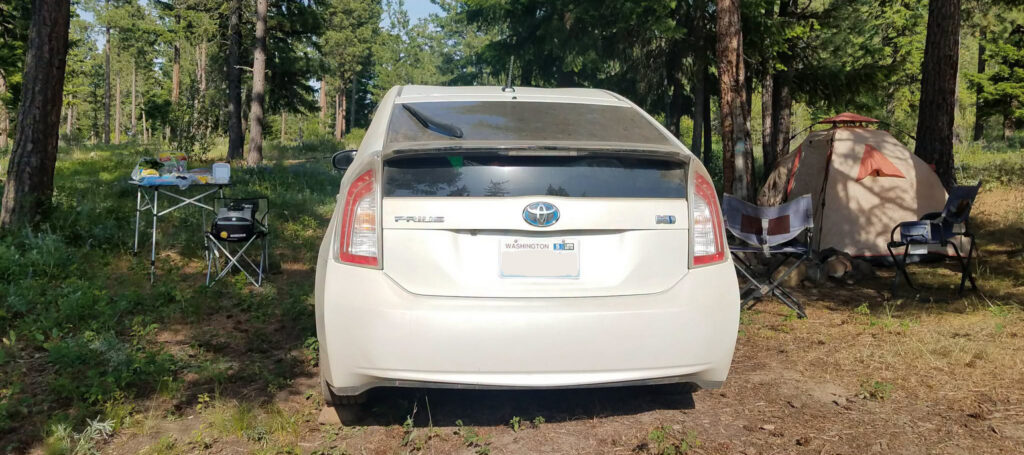
A Simple Home On Wheels by Suanne Carlson
It is one thing to say, “I lived out of a Prius.” It is another thing to look at a Prius and wonder: “OKAY, BUT WHERE DID YOU PUT EVERYTHING?”

(At one point I emptied my 2015 Prius to do some maintenance/cleaning, this is the amazing amount of the stuff, on a 10×10′ tarp, that was stored in Prius after going full-time. (2017))
The Prius worked for me because I did not try to turn it into a tiny apartment. I used it as transportation, storage, sleeping space, office, and secure shelter. Most of the actual living happened outside — in nature, at camp, with friends, around the campfire, at gatherings, and wherever the road took me.
That is why I say I lived OUT OF the Prius, instead of IN the Prius. I think of the Prius as a hard-sided tent with excellent gas mileage.
WHERE I SLEPT
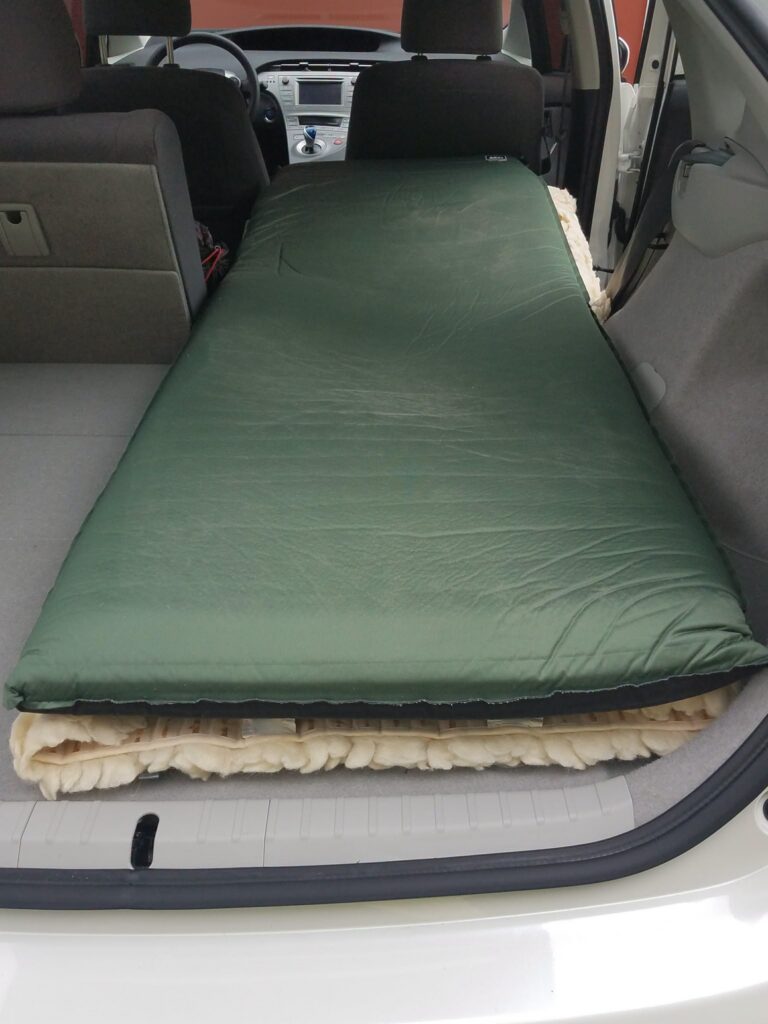
My bed was on the passenger side, behind the front seat.
The back passenger-side seat folds flat, and the front passenger seat moved forward about halfway. I slept behind the front passenger seat, stretched out toward the hatch.
For most of my Prius years, I used a 24″ x 72″ REI self-inflating 3.5″ sleeping pad. Later, I used a 5″ high-density foam mattress, also 24″ x 72″. Either cot or massage table sheets fit well.
That gave me a comfortable sleeping space.
WHAT SEATS STAYED USABLE?
When camped, the back driver-side seat stayed open. Of course, when driving, the driver’s seat was cleared and ready to go. On the rare occasion I had a passenger, the things stored on the back seat went on top of the bed.
That was one of the nice things about the setup: it could shift between “camping mode,” “driving mode,” and “I can make room for another human” mode.
CLOTHING STORAGE
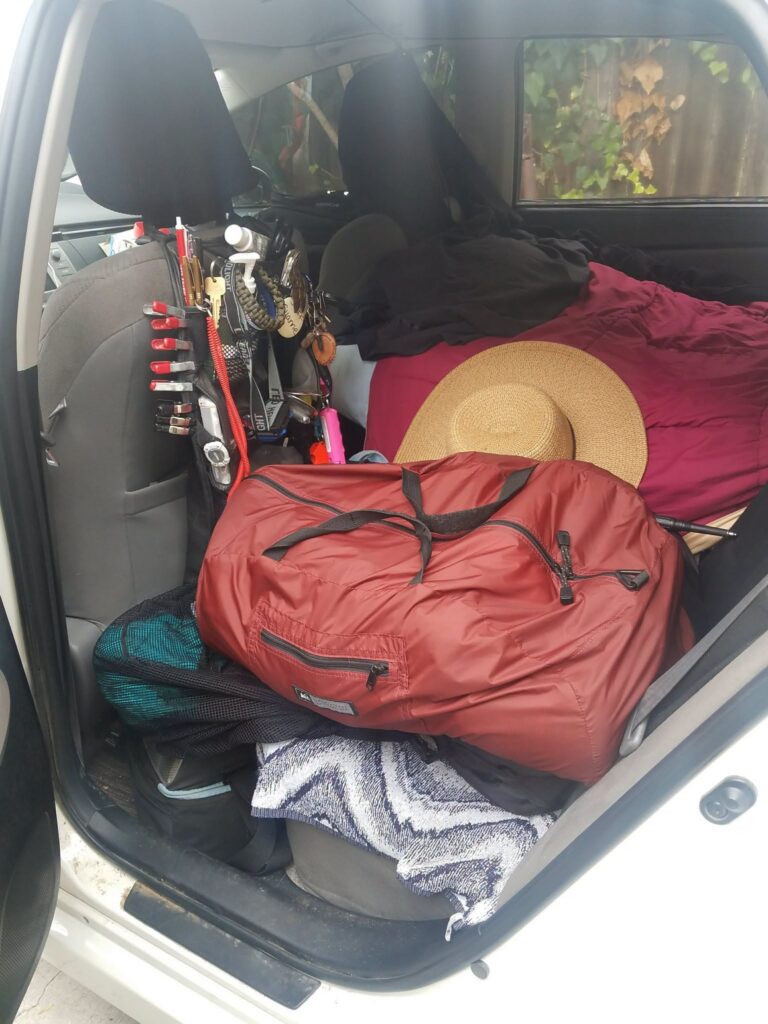
My clothing system was simple. Underwear and socks went into a smaller duffel bag. My other clothes were rolled up, rubber-banded, and stored in a larger duffel bag. Rolling clothes saved space and made it easier to find what I needed without turning the car into a laundry explosion. When driving, the duffel bags were stored on the back seat. When camping, they were in the driver’s seat.
Large outerwear, like a heavy coat, usually lived at the foot of the bed. Smaller outerwear — hats, gloves, and similar items — went into the larger duffel.
I used duffel bags for many purposes because they fit into the odd-shaped spaces common in vehicles. They also get smaller as they become emptier.
Of course, as the clean-clothes duffel got smaller, the dirty-clothes bag got bigger. Such is life.
FOOD AND COOKING GEAR
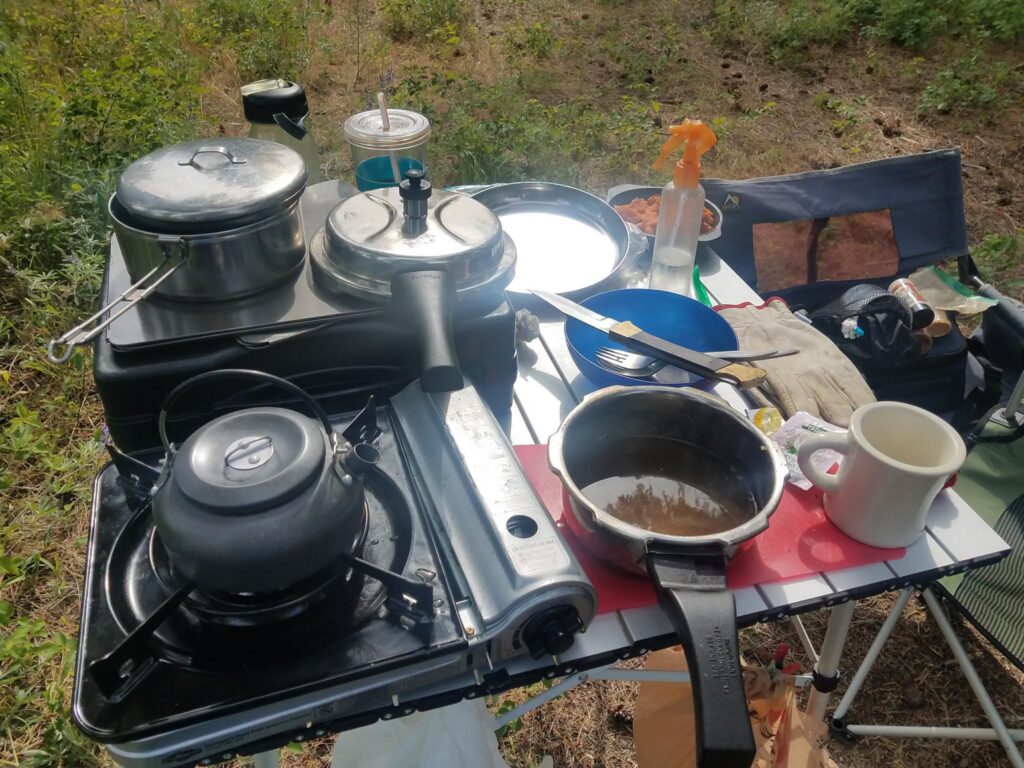
Food was stored in the front passenger seat area in a small crate for canned goods and duffel bags for everything else. Cooking gear, a butane stove, and a small folding table for meal prep lived in the hatch area, behind the back driver-side seat.
I cooked outside the Prius. That is an important part of understanding this kind of setup. The Prius did not need to contain a kitchen, dining room, living room, and office. It just needed to carry what was necessary to live mostly outdoors.
WATER
For daily use, I kept a couple of 1-liter water bottles for drinking and cooking. For storage, I filled up to four of my 10-liter water bladders — about ten gallons total. I refilled my smaller bottles from the bladders.
Like duffel bags, the water bladders took up less space as they emptied, unlike rigid water containers. In a smaller vehicle, that matters.
WINDOW PRIVACY AND BUG PROTECTION
For a curtain “rod,” I strung a small-diameter shock cord from behind the front seats to just in front of the hatch. I then hung black polyester fleece fabric from the cord as curtains. They were tied back when driving.
The two back windows were also covered with no-see-um netting to keep bugs out while the windows were open for air flow. I used mostly magnetic strips to hold the netting in place.
That gave me ventilation, privacy, and bug protection — three very important things when your bedroom has four wheels.

TEMPERATURE CONTROL
One useful thing about a Prius is that, as a Toyota hybrid, it can run the air conditioner while parked. The A/C is primarily powered by the hybrid battery, and the gas engine comes on periodically to recharge the system. When I was traveling in the Deep South, I was very thankful to have the A/C for cooling down enough to sleep in the heat and humidity.
The Prius is not as efficient for interior heat. Similar to most vehicles, it relies mostly on running the engine to generate heat for cabin warmth.
Like most vehicle-based lifestyles, Prius living works best by following the good weather as much as possible.
POWER AND CHARGING
My electrical power system was simple. I did not use household 110-volt connections. I charged my cell phone from the Prius’ accessory plug (cigarette lighter). When I had a laptop, I used a 12-volt laptop charger and charged it from the same source.
As very small power stations became available, I began keeping one in the front passenger seat area. I would charge the power station from the Prius, mostly while driving, and then charge my phone and laptop from the power station.
It was a simple system, not meant to run household appliances. Yet, it kept my important electronics charged, which was all I needed.
UNDER THE HATCH
The hatch area carried the heavier bulky camp items, which included:
- water bladders
- cooking gear, butane stove, folding table
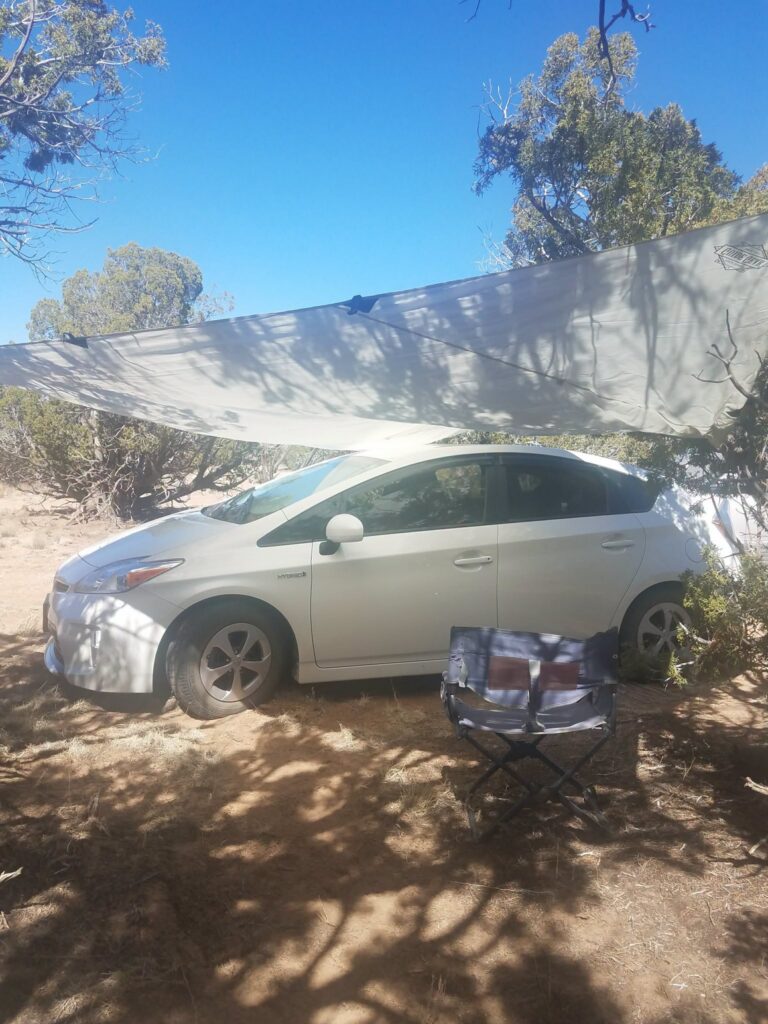
- tent and tarp for storing items outside of the Prius
- tools, emergency gear, full first aid kit
- rodent deterrents
- laundry and cleaning supplies
- heavy coat
- folding chair
When you live out of a small vehicle, a good folding chair is not a luxury. It is your living room.

UNDER AND AROUND THE BED
Behind the front passenger seat, under the head of the bed, I kept things I wanted protected or close by:
- medicine-cabinet items
- important documents in a fire-resistant pouch
- extra blankets
- toileting items
The toileting items included a 2-gallon bucket, pee bottle, toilet paper, plastic bags, and a smell-proof container were kept at the middle point of the floor. Not glamorous. But very practical. Nomadic life includes sunsets and mountain views. It also includes knowing exactly where the toilet paper is at 2 a.m.
ITEMS ALWAYS WITHIN EASY REACH
When inside the car at camp, I would sit in the back driver-side seat, next to my bed. That space was able to give me privacy, security, and shelter from uncomfortable weather. It’s where I prepared for bed, got cleaned up for the day, dressed, worked, and relaxed.
At night, my shoes were stored under the driver’s seat, within easy reach if needed during the night or first thing the next morning.

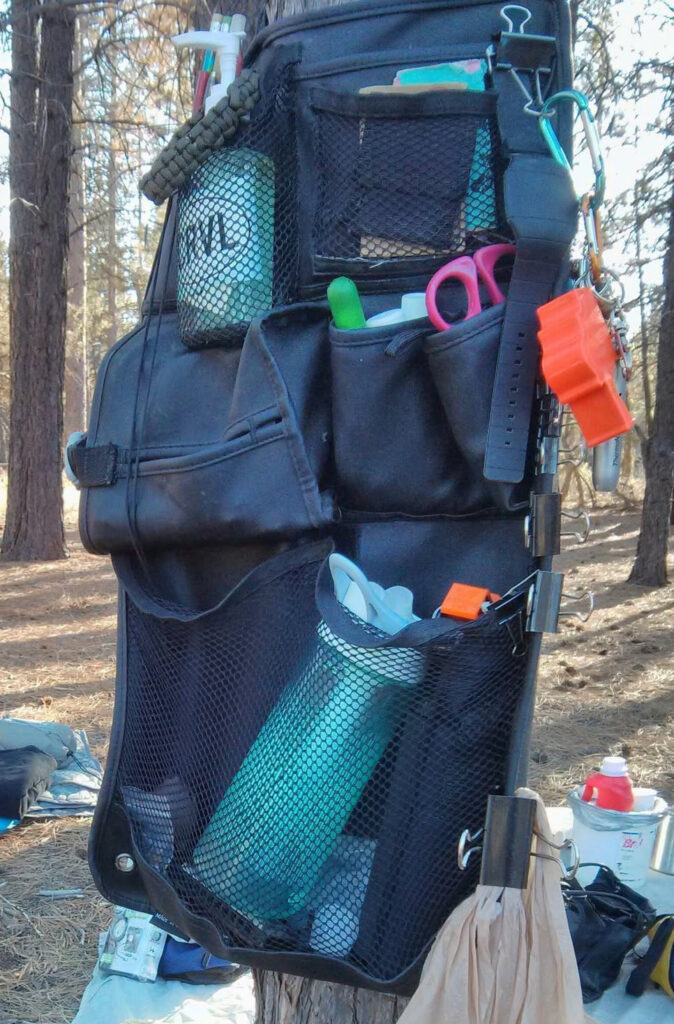
I hung a seat-back organizer in front of the seat. That organizer held many of the small things I wanted close by:
- hand sanitizer
- water bottle
- flashlight
- lip balm and lotion
- scissors and pocket knife
- safety items, including bear spray, SPOT GPS device, and emergency whistle
- a trash bag clipped to the bottom
- car keys on a neck chain, with an alarm button for safety
The keys were especially important. During the day, I wore them on a neck chain. At night, they stayed within reach for both convenience and safety. With keys at the ready, I could quickly lock, unlock, or move the car if needed.
I also kept a small duffel bag on the center console during sleep. It held:
- cell phone
- wet wipes, spray bottles, other hygiene items
- weekly meds and vitamins, ibuprofen, Tylenol
- antibiotic ointment with a few Band-Aids
During the day, this same duffel bag also held my night clothes and was stored on top of the bed just behind the passenger seat.
NOOKS AND CRANNIES
When living out of a small car, every square inch is utilized — the door pockets, under the seats, the cubbies by the Prius’ tail lights. Although areas are typically calculated in “square” inches, there’s nothing square or angular about these small spaces. So, soft-sided containers are needed to maximize storage for the odds and ends placed in these weird-shaped areas such as:
- a bag of empty plastic grocery bags
- battery jump starter and small air compressor
- a bug-out bag of emergency items in case I need to leave my car
- a sewing kit and small craft items
- fire blanket and extinguisher
- dog treats for my campmates’ pets
- flip flops for showering in public facilities
Although these are rather random items in random spaces, everything had a specific purpose with its designated place.
WHAT CHANGED WHEN I WENT FULL-TIME
When I was part-time, if something did not fit in the Prius, I left it at my house. When I became full-time, everything I owned had to earn its place.
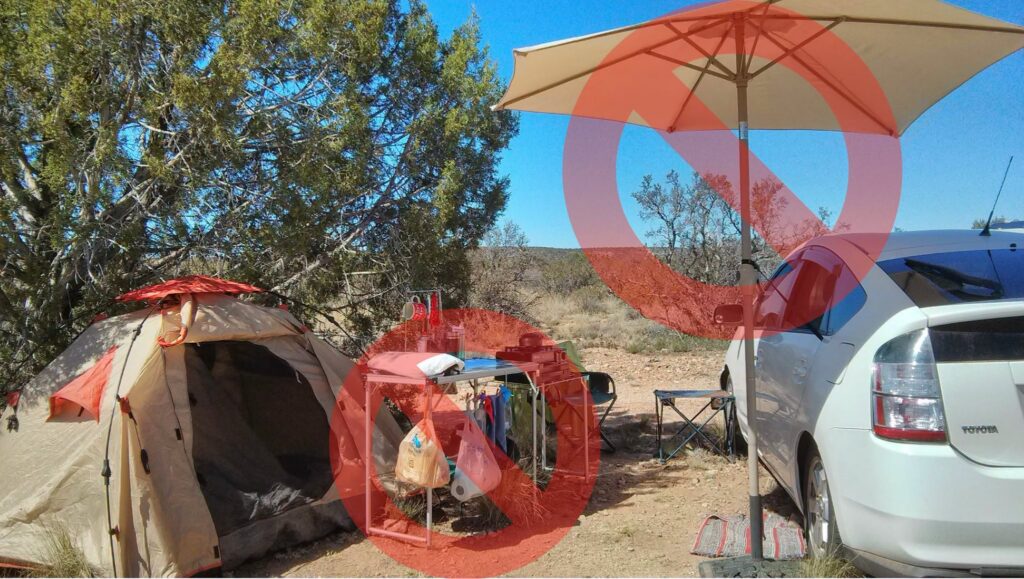
I added a heavy fire-resistant safe for important papers and a few small mementos. It lived behind the front passenger seat. But I also had to let go of things I thought I could keep. Two larger items I gave up after going full-time included:
- an umbrella for shade
- a kitchen setup for outside
They were useful, but not useful enough to justify the space they consumed. Sometimes one’s best planning still needs to be tweaked after having lived experience.
A SMALL SPACE TEACHES THE DIFFERENCE BETWEEN “NICE IDEA” AND “ACTUAL NEED.”
WHY IT WORKED
The Prius worked because everything had both a job (or jobs) and a place.
- The bed was the bed, and functioned as a desktop when working inside.
- The hatch held larger pieces of gear.
- The front passenger area held the food and a small power station.
- The duffel bags held clothes and gear throughout the vehicle.
- The seat-back organizer held small essentials.
- The outdoors held my heart and my true living space in nature.
It was simple, flexible, efficient, and livable for someone who loves travel and nature.
The Prius is also a practical, efficient daily driver, a weekend camping shelter, and a possible first step into nomadic life.
You do not have to start with a large RV or a complicated van build. Sometimes a reliable car, a comfortable sleeping pad, smart organization, and a willingness to live mostly outside can open a much bigger life.
For me, it is the difference between camping and RV’ing. I was not trying to bring a whole house with me. I was using the Prius to get outside, stay mobile, travel economically, and have a secure place to sleep at night.